
President's Message
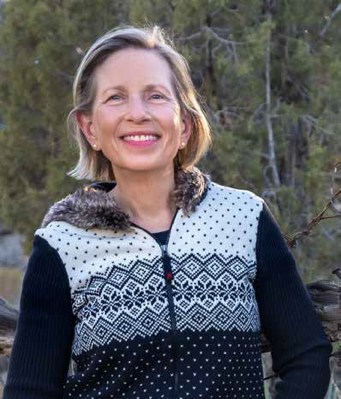
Attacks on the environment seem relentless, from the downsizing of vital agencies to the elimination of large swaths of public land. Campaigning, letter writing and voting help a lot and, also, funding. I am a lifetime member of the Sierra Club and particularly fond of Earthjustice, where lawyers are making headway. My husband and I donated land to The Wildlands Conservancy, and we have The Nature Conservancy in our trust, as well as Keep Sedona Beautiful. It's not a mystery my involvement in Keep Sedona Beautiful includes both time and money.
Become a KSB member or renew today; our membership needs a boost. Join or renew by clicking THIS LINK.
And, if you feel generous, consider giving QCDs and RMDs. Learn more by clicking THIS LINK. You'll help educate all ages about what's important. Thank you.
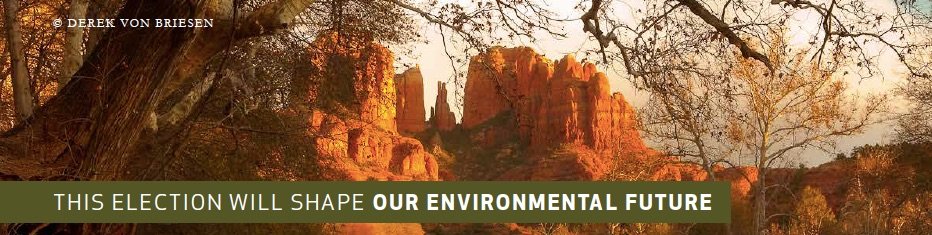
This Election Will Shape Our Environmental Future
Elections Have Consequences
It is easy to think of national elections as distant from daily life in the Verde Valley, but decisions made in Washington directly shape what happens on the ground here. Funding for national forests, air and water quality standards and protections for endangered species are all set or eliminated at the federal level. The national approach to these issues determines how much support local land managers, conservation groups and municipalities receive as they work to protect our natural resources.
When federal priorities shift away from conservation, the effects are not abstract. Grant programs dry up and enforcement of environmental regulations weakens, leaving state and local jurisdictions to fill gaps. Voting with these connections in mind is one of the most direct ways you can influence what kind of support or obstacles we will face in the years ahead.
Public lands are vulnerable
The Coconino and Prescott National Forests exist in their current form because of policy choices, not accidents of nature. Elected officials at every level of government make decisions about leasing, development and access that determine whether these lands remain protected for future generations or become vulnerable to extraction and privatization pressures. Candidates differ significantly in their commitment to keeping public lands in public hands. Researching where they stand on land management, permitting and conservation funding gives you a direct way to help determine whether our public lands remain protected.
Climate policy affects us every day
Climate change is already reshaping our region through prolonged drought, dwindling water supplies and an escalating threat of wildfire. The scale of these challenges requires coordinated action at every level of government, from investment in clean energy to serious commitments to reducing emissions. The effectiveness of that action depends heavily on who holds office. Some candidates prioritize aggressive climate action and clean energy investment. Others look to roll back these efforts. Because the consequences of inaction accumulate over time and are difficult to reverse, this is an area where your choices can have a significant impact.
Local and state elections impact us directly
While national politics dominates headlines, many of the decisions that most directly affect Sedona and the Verde Valley are made by local and state officials: city councils, county supervisors, Arizona Corporation Commissioners and state legislators. They set zoning rules, approve development projects, oversee water conservation efforts, regulate utilities and determine how aggressively local governments pursue sustainability goals. Researching these candidates' positions on responsible growth, water conservation and open space preservation is just as important as researching candidates for higher office.
Your vote is powerful
Of everything you can do to protect the environment, voting may be your single most consequential action. Elected officials write the laws, set the budgets and appoint the regulators who determine environmental outcomes at every level. No amount of individual sustainable living can substitute for policy decisions made by those in power. With so much at stake for the Verde Valley's water, air, land and wildlife, this election offers you a meaningful opportunity to have your voice heard.
We encourage all KSB members and supporters to research candidates thoroughly, learn about their environmental positions and vote for those who will best protect this place we all call home.
Resources to research candidates
- www.Vote411.org is provided by the League of Women Voters, which sends questionnaires directly to candidates so you can see stances in candidates' own words alongside their background and history.
- www.votesmart.org is a long-running project that pulls together candidate bios, voting records, interest-group ratings, speeches, and campaign finance data, aiming for factual, unbiased information without party affiliation. Also has a "Political Courage Test" tracking whether candidates answered issue questionnaires.
- Ballotpedia is sponsored by the nonpartisan, nonprofit Lucy Burns Institute, covering federal, state, and local elections, candidates, and ballot measures.
- Arizona Ballot Guide is built from official filings, BallotReady, campaign websites, and candidates' own public statements, with no endorsements, rankings, or paid placement. It has an address-lookup feature to show your specific ballot.
Recent Federal Actions Affecting the Environment
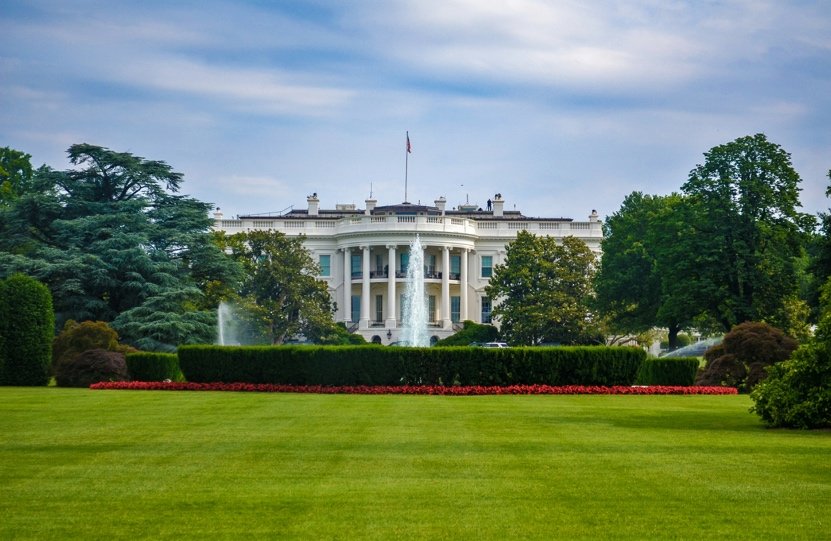
Keep Sedona Beautiful has worked diligently to protect the beauty and health of the Verde Valley, one litter drive, one sign ordinance, one land purchase at a time. But we've always known that Sedona doesn't exist in a bubble. Decisions made in Washington shape the tools available to us here, such as funding for clean air and water enforcement, rules governing our national forests and the science behind the policies that protect us from wildfire and drought. Over the past two years, federal action on several fronts has changed those tools significantly. Here are some of the recent changes, and why we believe they matter to Verde Valley voters.
Executive Action
Reversing federal conservation commitments
On the current administration's first day in office, the Unleashing American Energy order was signed, prioritizing fossil fuel production and formally rescinding the prior administration's commitment to the "30 by 30" goal of conserving 30 percent of our land and water by 2030. The order also began a wave of subsequent actions that rolled back conservation policies supporting that goal.
Additional orders soon followed, and an energy dominance agenda prioritized fossil fuel extraction interests as a favored use of America's public lands. These orders threaten existing land protections and conservation measures.
Rolling back environmental review requirements
The National Environmental Policy Act (NEPA) has required federal agencies to study a major project's environmental impact before approving it. In February 2025, the Council on Environmental Quality rescinded its NEPA regulations, shifting implementation to individual agencies and streamlining the review process. This change was one of ten Project 2025-aligned actions related to limiting environmental reviews that were completed or attempted within the administration's first year.1
KSB understands the need to review regulations that are excessively restrictive, but environmental review isn't just red tape. It's the mechanism that lets a community learn what a mine, a pipeline or a development will do to its water, wildlife and air before the damage is done, not after. Weaken that process, and the risk doesn't go away. The public simply finds out less, and finds out later.
Prioritizing above all other uses of public land
The Bureau of Land Management rescinded the Public Lands Rule, which had put conservation on equal footing with other priorities across the BLM's 245 million acres. A subsequent order went further, directing that mining and extraction be prioritized above other use of public land. Large-scale lease sales expose millions of acres to drilling and mining, including sensitive lands and popular recreation areas.
Multiple-use management has balanced recreation, grazing, wildlife habitat and resource extraction on our public lands for generations. Ranking mining above all other uses changes the balance. It changes how our own Coconino and Prescott National Forests are managed in the future, even before a single mining project has been proposed nearby.
Rolling back Pacific Ocean national monument protections
In June 2026, an order rolled back protections for the three remaining Pacific Ocean national monuments, opening more than 300 million acres to commercial fishing. These protections had shielded coral reefs, seamounts and marine ecosystems from commercial extraction for years.
While Sedona is landlocked, actions such as this set precedents that can impact us. Now, protections built over years of scientific study and public process can be undone with a single order. The same tool used against ocean monuments could be applied to any protected landscape. Conservation gains are never permanently secure without sustained public attention.
Congressional Legislation
Rescinding major clean energy and climate funding
On July 4, 2025, the One Big Beautiful Bill Act passed by Congress was signed into law. Buried inside this sweeping tax and spending bill was the rescission of funding for environmental programs originally allocated under the Inflation Reduction Act. That funding had supported clean energy deployment, energy efficiency and pollution reduction nationwide.
Programs like these depend on long-term investment to be effective. Pull the funding mid-stream and projects already underway stall. The broader shift toward cleaner energy slows down. That's a cost that lands on areas like the Verde Valley, which benefit directly from lower-cost renewable power and cleaner air.
Repealing a methane emissions fee on oil and gas producers
On March 14, 2025, the first two environmental Congressional Review Act resolutions of 2025 were signed into law. One rescinds the EPA's Waste Emissions Charge on methane from oil and gas producers. Another rescinds safety and environmental requirements for offshore drilling. Under the Congressional Review Act, a rule repealed this way cannot be reissued in substantially the same form without new authorization from Congress.
Methane is a far more potent greenhouse gas than carbon dioxide in the near term, which made this fee a meaningful tool for slowing near-term climate change. Repealing it removed the financial incentive for producers to capture and reduce their methane leaks. And because it can't simply be reinstated by a future administration through an Executive Order, this isn't a temporary rollback. It is a durable one.
Cutting the EPA's budget by nearly a quarter
On January 23, 2026, H.R. 6938, the "Commerce, Justice, Science; Energy and Water Development; and Interior and Environment Appropriations Act, 2026", was signed into law.
The Interior and Environment portion of that bill cut the Environmental Protection Agency's funding by $2.1 billion, a 23 percent reduction. It prioritized energy development and rolled back what the bill's authors called burdensome prior-administration rules.
A budget is capacity. It's what allows the agency to inspect facilities, respond to contamination, review permits and enforce the environmental laws already on the books. A cut this size doesn't just shrink new programs. It weakens EPA's ability to enforce the clean air and clean water protections we depend on, at the very moment many of those protections are being reconsidered elsewhere. Funding decisions like this one are made by Congress. Members of Congress are elected by voters like you.
Recent Federal Actions Affecting Science
Keep Sedona Beautiful has been steadfast in promoting science-based decision-making. We're gravely concerned that policymakers are ignoring objective science in favor of partisan posturing. When the machinery of federal government shifts authority away from independent scientific review and toward political decision-making, the effects reach well beyond any one agency or report.
Congressional Legislation
Overriding a nonpartisan technical finding
In June 2025, Congress passed three joint resolutions revoking EPA waivers that had allowed California to enforce its own vehicle emissions standards, including requirements phasing in zero-emission cars and trucks. Congress did this despite formal, nonpartisan findings from both the Government Accountability Office and the Senate Parliamentarian that these waivers weren't even the kind of rule subject to this procedure.
This wasn't just a disagreement over emissions targets. It was also about Congress overriding its own nonpartisan referees on a technical and legal question to get the outcome it wanted. California and ten other states have since challenged the action in federal court. However the litigation turns out, the episode shows how easily technical and scientific determinations can be set aside when they're inconvenient.
Rescinding federal funding for clean energy research and innovation
The same tax and spending law signed in July 2025 that rescinded environmental program funding also pulled support from clean energy research and innovation, including next-generation solar, wind and battery technology development. Scientific breakthroughs depend on sustained investment, often over many years, before the technology becomes commercially viable. Pull the funding mid-stream, and you don't just slow the projects underway. You discourage the long-term investment that produces the next breakthrough in the first place.
Repealing science-based safety and environmental review requirements for offshore drilling
In March 2025, Congress used the Congressional Review Act to repeal a rule that had added environmental and safety requirements for offshore oil and gas exploration on the Outer Continental Shelf. Rules of this kind are typically developed using engineering and environmental science accumulated over decades, including lessons learned from past offshore drilling incidents.
As noted above, because of how the Congressional Review Act works, this rule can't be reissued in substantially the same form without new authorization from Congress. The safety and environmental standards it contained can't simply be restored by a future administration. Whatever one thinks about offshore drilling, repealing evidence-based safety requirements in a way that precludes reinstating them takes away our ability to respond if new findings show they were needed after all.
Executive Action
Reconsidering the science behind climate regulation
On the first day of the Current Administration, an executive order disbanded the interagency working group responsible for calculating the "social cost of carbon". That figure assigns a monetary value to carbon emissions to weigh the economic damage of greenhouse gas emissions against the cost of regulating them. The same order directed regulators to reconsider the scientific and legal basis for EPA's 2009 finding that greenhouse gases endanger public health.
Terminating a major national science assessment weeks before its scheduled release
In January 2025, an executive order ended the National Nature Assessment, a first-of-its-kind federal report on the condition of America's lands, water and wildlife. More than 150 scientists and experts from academia, industry and nonprofits had spent over two years on it. It was nearly finished when it was cancelled.
Reports like this exist to give policymakers, land managers and the public a shared, science-based understanding of where our natural resources stand and where they're headed. Ending it days before publication didn't just delay the information. It threw away years of completed work and left a gap we won't be able to fill before the next assessment cycle, years from now.
Issuing an order giving political appointees new authority over what counts as valid research
In May 2025, an executive order titled Restoring Gold Standard Science directed federal agencies to apply a new set of standards to federally funded research, including provisions that allow agency leadership, not independent scientific review, to determine whether research meets the bar of "reproducible" or "unbiased."
Critics have argued the order's central claims about the state of American science are inaccurate, and warned that placing this kind of authority in political hands opens the door to research findings being accepted or dismissed based on whether they're politically convenient rather than scientifically sound.
Pulling federal climate science from public view
The National Climate Assessment, a comprehensive report on climate change's effects on the United States that Congress has required every four years since 1990, was halted in 2025. The administration cancelled the contract supporting the scientists who coordinate the report and dismissed all 400 volunteer authors working on the sixth edition. The assessment and its supporting climate.gov website were removed from federal servers entirely.
Farmers, emergency planners, insurers and local governments have relied on this kind of federally coordinated climate data to plan for wildfire, drought and extreme weather. Take the information away, and the risks it described don't go anywhere. Instead, we lose one of the best tools we had for preparing.
James Havens Commissions Open
James Havens is an award-winning Anchorage-based painter and sculptor known for large-scale oil paintings and installations depicting wildlife, prehistoric creatures, and historic subjects. He recently collaborated with Keep Sedona Beautiful and the City of Sedona to create a monumental mural depicting Sedona's history and the Ranger Station. James is returning to Sedona to offer commissioned works.
To learn more about this unique opportunity, visit www.havens.com or contact KSB at info@keepsedonabeautiful.org.
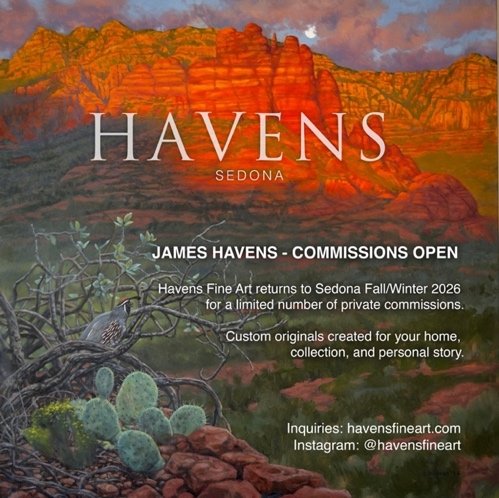
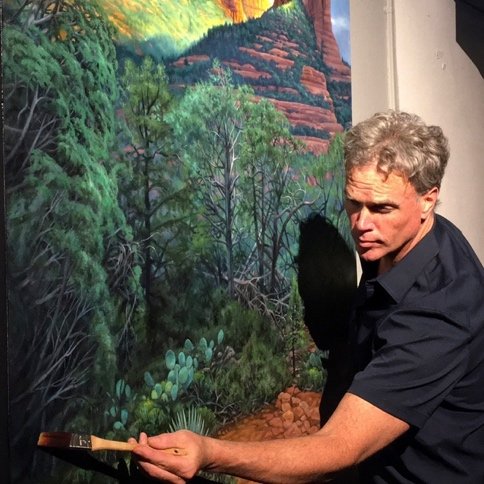
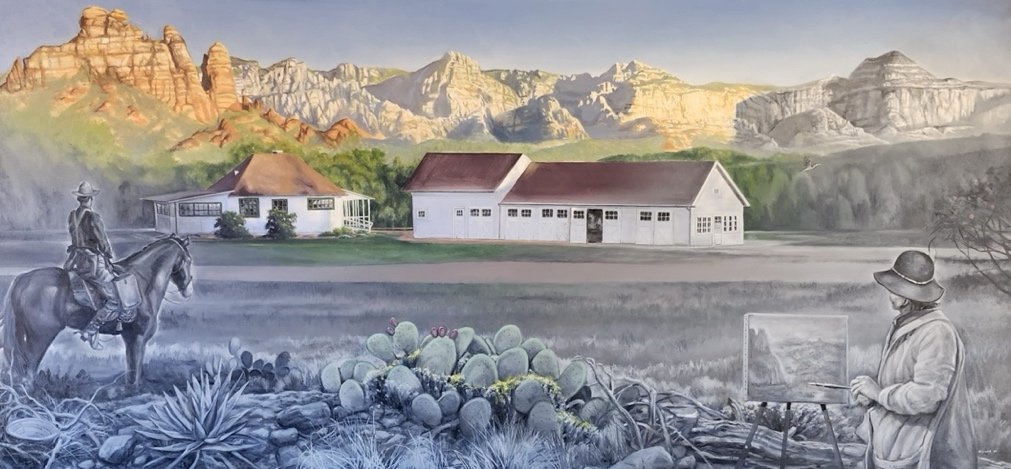
Private Commission Scale — Fall/Winter 2026 Sedona Archive
Perfect for study, bedroom, small wall
Most requested size — living room, office
Large wall, fireplace, entry
Major wall, full story piece
All originals oil/mixed media on canvas. Includes concept call + 2 progress previews.
Framing & shipping separate. 50% deposit to book.
www.havensfineart.com · @havensfineart
Together, We Make Sedona Bloom
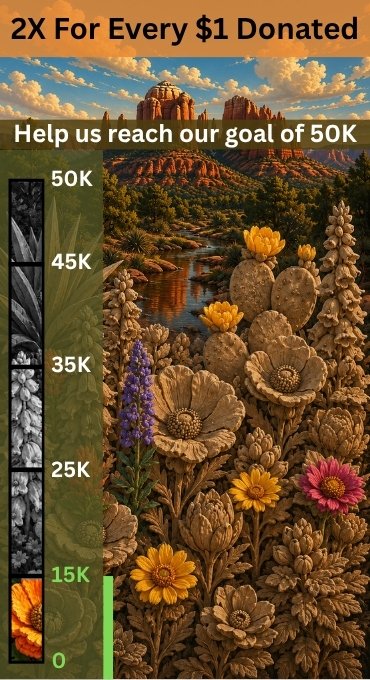
Every year, our community comes together to help protect the scenic beauty and natural environment of Sedona and the Verde Valley. This year, our 2027 Membership Matching Campaign has a goal of raising $50,000, and we'd love your help to make it happen.
Norris and Carolyn Peterson have generously provided the seed funding to help this year's campaign take root. We are also grateful to Lynn Zonakis and Craig Swanson, whose generous support is helping the campaign bloom from the very beginning.
As you'll see in the artwork above, the landscape begins with flowers carved from sandstone. With each fundraising milestone, more flowers bloom into vibrant color, symbolizing the growing impact of your generosity. By the time we reach our goal, the entire landscape will be alive with color, reflecting what we can accomplish together.
Your membership or donation supports Keep Sedona Beautiful's work throughout the year, including litter cleanup, our microtrash team, environmental education, sustainability, dark sky preservation, and protecting the unique beauty that makes Sedona such a special place.
Please help us make Sedona bloom.
Donate, join or renew your membershipUpcoming Speaker Series Events
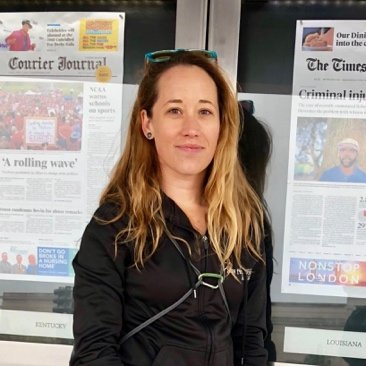
The Arizona Trail: An 850-mile Mountain Bike Exploration of Climate Change
Journalist and Ecologist Joan Meiners will share this presentation. Along the 850-mile Arizona Trail, which spans the length of the state from Utah to Mexico, diverse ecosystems showcase how climate change is actively altering life as we know it across the Southwest. During fall 2025, The Arizona Republic newspaper's climate reporter, who earned a Ph.D. in ecology before becoming an award-winning journalist, spent seven weeks traveling the full trail on her mountain bike to witness these threats, document their impacts, and consult with experts on solutions. Rich with photos and video from the journey as well as scientific expertise and cultural context, this presentation takes audiences through the state's biggest environmental challenges and opportunities, mile by mile. Joan Meiners' trail journey is a scenic and dynamic window into some of Arizona's most pressing problems, told from the frontlines of journalistic exploration through literal living landscapes. This program is made possible by Arizona Humanities.
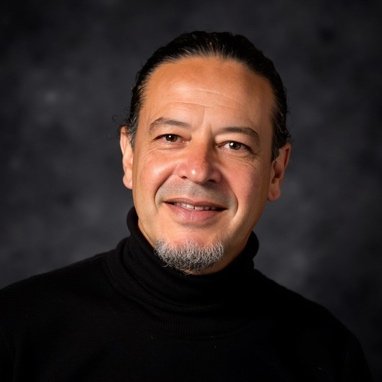
Living Landscapes: Food, Memory and the Sonoran Desert
Jeffrey Lazos Ferns, Chef and Artist, will share how to explore Arizona's Indigenous Foodways and the Sonoran Desert as a living archive of cultural knowledge, focusing on how Indigenous foodways and ecological relationships have shaped Arizona communities over generations. Through stories of indigenous plants, including the Sonoran Desert tree pantry, Sonoran Desert cactus pantry, and the Sonoran Desert shrub apothecary, the presentation highlights how plant, food, and wildlife traditions are deeply tied to land, identity, and survival. Ferns connects desert ecology to themes of history, migration, and cultural resilience. Audiences will see Arizona's landscapes not as passive settings but as active forces shaping community life, offering insight into sustainable practices and cultural continuity in the face of environmental change. Note: This presentation will include tasting samples from the Sonoran Desert plant scape. This program is made possible by Arizona Humanities.
Turning 70½ or 73? Your IRA Can Help KSB — Tax-Free
Remember turning 21? Two later birthdays matter just as much if you have a Traditional IRA — age 70½ and age 73. Here's what they mean, and how to avoid an unnecessary 10%–25% tax penalty.
- Age 70½ — you can start a Qualified Charitable Distribution (QCD). You may give directly from your IRA to KSB, tax-free, up to $111,000 per year (the 2026 limit; it's adjusted annually for inflation). The gift must transfer directly from your IRA custodian to KSB. A check from your brokerage or a QCD form works. Money that passes through your personal checking account does not qualify.
- Age 73 — your Required Minimum Distribution (RMD) begins. The IRS requires you to withdraw a minimum amount each year from your Traditional IRA. If you turned 73 in 2026, you have until April 1, 2027 to take your first RMD. After that first year, the deadline is December 31 annually. A QCD counts toward your RMD, so donating what you don't need satisfies the requirement without adding to your taxable income.
- QCDs and RMDs apply only to Traditional IRAs — not Roth IRAs, since Roth contributions are taxed when invested, not when withdrawn.
- Want to give now and receive income for life? A Charitable Remainder Trust (CRT) lets you make a gift today, take a tax deduction in the year you set up and fund the trust, and receive regular payments — with the remainder eventually supporting KSB.
As always, KSB encourages you to discuss any charitable distribution decisions with your financial or tax advisor.
Adventure Guides Needed
KSB is gearing up for our first full year of Discover the Wonder – An Environmental Education Adventure. Students explore the EcoHub Educational Garden to learn about Sedona's geoscience, wildlife, native plants, and how the Indigenous people used them to survive and thrive. We are looking for volunteers like you — nature enthusiasts who love our beautiful environment, enjoy sharing with young people, and are dedicated to preserving it.
Thanks to the City of Sedona, we received a generous grant to offer this unique and extraordinary program to Sedona students in 5th–10th grade.
We begin our garden tours asking students what they see when they look out at the garden. They often respond that they see trees, rocks, and plants. Our Adventure Guides might respond with something like, "I also see a grocery store, pharmacy, and Walmart for shoes and clothing."
With a Dino Diane's Field Journal in hand, students have 15 minutes in each of 4 garden loops to jot down things they learn and draw the plants described, making a real connection to nature. After an hour, the garden group switches with the classroom group, and they attend a high-energy, interactive presentation where they dive deep into Sedona's geologic past and learn how to preserve our beautiful environment by practicing the Leave No Trace 7 Principles and hiking sustainably and safely.
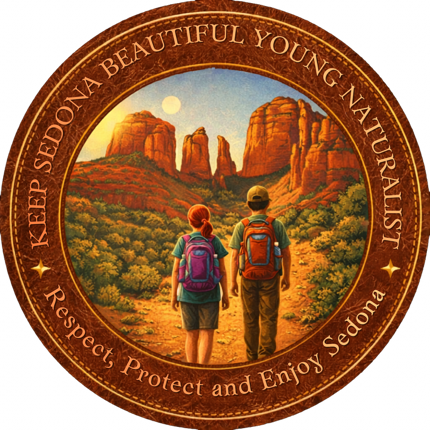
Students from Red Rock Junior/Senior High School, Running River School, West Sedona School and Sedona Charter School will be invited to attend these field trips at no cost. They will receive a high-quality, full-color field journal, KSB Young Naturalist sticker (shown above) and a copy of Saddlebags of Gold. This book is a magical science adventure written by our Director of Education, Diane (D. J.) Kristoff, to inspire them to disconnect from their screens, put on their hiking boots, and discover the wonders of nature while getting healthy in the process.
We have 6 field trips already scheduled and are working to schedule four more. We'd love to have you join us as a volunteer Adventure Guide. Training is provided. Each field trip requires about three hours of your time — from 8:30 am to 11:30. Call KSB at 928-282-4938 or email us at info@keepsedonabeautiful.org if you're interested in making a difference in a young person's life.
And you WILL make a difference. Here's what Eric Hansen, a math teacher from Camp Verde Middle School, had to say about it after our first field trip earlier this year:
"Our 6th-grade students from Camp Verde Middle School recently had the pleasure of visiting the Sedona KSB EcoHub, and the experience was nothing short of exceptional. From start to finish, the program was professionally organized, deeply engaging, and perfectly focused on the wonders of Sedona."
And here's what the sixth-graders had to say:
- "I liked learning about xeriscaping." — Aveny
- Kiara said, "Javelinas eat prickly pear cactus, spikes and all. This place is fun!"
- "The most interesting thing I learned was that Environmental Sustainability means using nature responsibly." — Joshua
- "Sedona was once under a sea, and the rocks are red because they rusted." — Leana
- Christina said, "Plants are medicine, sandals, and gum!"
- "That dinosaurs roamed Arizona, but not Sedona." — Reagan
From Wildcatting to Litter Lifting — a Life of Service
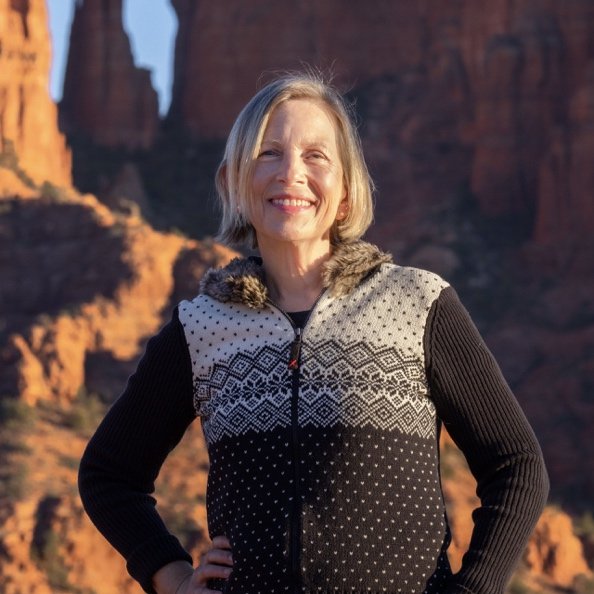
More than forty years have passed since Carla Williams worked in the frozen desert of Alaska's North Slope with temperatures often at -50°. Since then, she moved to the high desert of Sedona and is now the president of Keep Sedona Beautiful (KSB).
Her work in Alaska led her to write the book Wildcat Women, a collection of fascinating stories from her interviews with fourteen women cohorts who joined the workforce in the Alaskan oil fields to complete the herculean feat of laying 800 miles of oil and gas pipeline.
Big challenges are her specialty. She began her residency with KSB as a litter lifter. She and her neighbor decided to clean up all of Hwy 179. "Down in the ditch, even if there was something past the barbed wire, we'd shimmy under...picking up tons and tons of garbage...After 179 we did Beaverhead Flats...and we found over 200 wine bottles, a loaded gun (there's a story!), money, a brand-new popcorn popper still in the box, brand new tools, and so much more garbage."
As time passed, Carla became Chair of Litter Lifting and then Vice President of KSB. Today she is in her second year as President and co-chairs KSB's Indigenous Peoples Awareness Committee. Each of these roles is strictly volunteer.
She has always supported environmental causes and is a lifetime member of the Sierra Club. She also started a women's health nonprofit and worked as a lobbyist for the organization in Washington DC and Juneau, Alaska.
Carla is not only an adventurer, but she is also a teacher. She is a trail guide for vacationers staying at Enchantment and is Director at Large for Great Decisions of Sedona, which is a member-led group, exchanging knowledge, insights, and concerns through in-depth discussions, presentations and videos.
Carla's philanthropy reflects her belief in giving back to the community. She and her husband joined the Legacy Family of KSB through a trust in their estate plan. She wanted to give to an organization that will continue its good work to improve the environment. KSB has "been around for 54 years and is able to survive with mostly volunteers. There's a good chance it can continue that way." Her estate planning attorney suggested they use Arizona Community Foundation at Sedona to establish a trust that is managed by the foundation. When they pass away, the Community Foundation has the instructions of where to disperse the funds in their trust.
By putting their assets in the trust, there will be no probate, which avoids any lengthy court process that could delay payment to the beneficiaries.
"We didn't want a situation where all the money goes to the government," Carla said. No one wants to think about their mortality, but for practical purposes it is helpful to those we love to have our affairs in order.
Carla is focused on the sustainability of KSB. "We don't have the bandwidth to solve the problems of the environment in the nation. So what KSB has decided to do is work with like-minded organizations in town and do what we can to be sustainable. And if our own future is sustained, we can do a lot." Right now, that sustenance begins not only with the volunteers lifting litter, but everyone who cares about the environment doing their part to support that cause.
If you are interested in joining the KSB Legacy Family, contact Carla Williams, carlawmsaz@outlook.com, for details.
2026 Awards of Excellence — Part 2
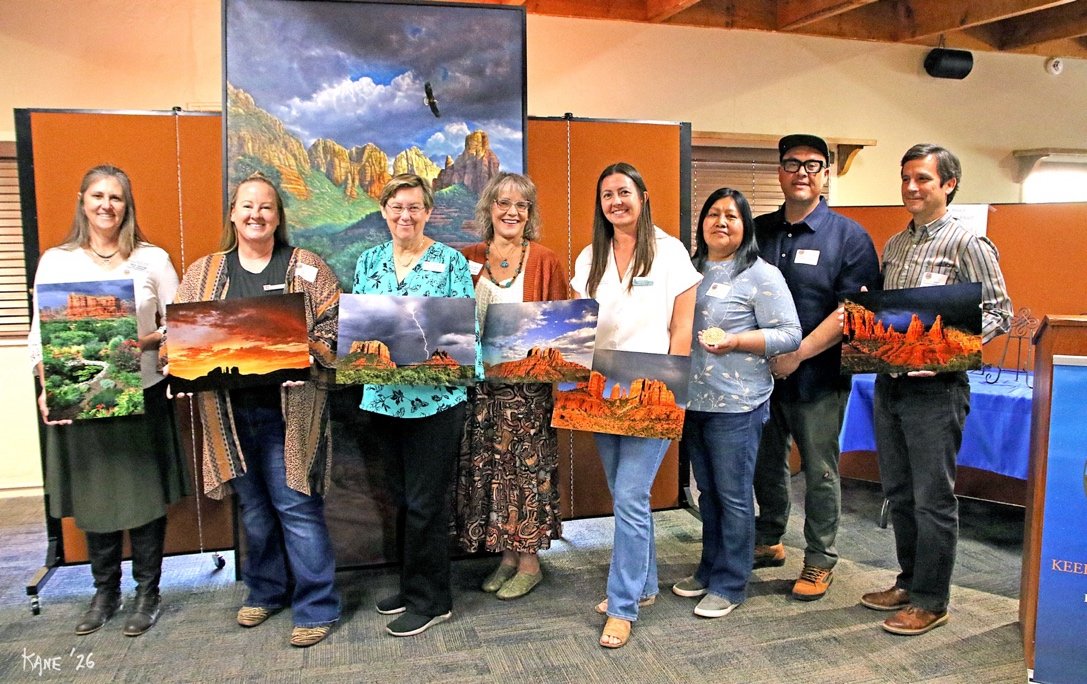
Keep Sedona Beautiful celebrated outstanding community leadership in April of 2026 at our Annual Awards of Excellence ceremony, recognizing individuals, companies and organizations whose work supports KSB's mission "to protect and sustain the scenic beauty and natural environment of Sedona and the Verde Valley."
We featured 3 of our awardees in our summer issue and the remaining 3 below.
Alice Madar received an award for Environmental Stewardship on behalf of the International Hummingbird Society, headquartered in West Sedona. For nearly 30 years, the organization has educated the public about hummingbirds, critical pollinators facing steep population declines. Through the Sedona Hummingbird Festival, garden certification programs, live banding demonstrations and extensive outreach, the Society inspires conservation and protects vital habitat across the region.
For more than fifty years, Northern Arizona Audubon Society has protected birds and the habitats they depend on. The organization manages two key preserves, the Sedona Wetlands Preserve and Bubbling Ponds at Page Springs Fish Hatchery, maintaining trails, hosting bird walks and offering free environmental education. Their survey work helped secure Important Bird Area designation in Camp Verde, paving the way for the creation of Rockin' River Ranch State Park. For this work, they received an award for Environmental Stewardship, which was presented to Caroline Morgan.
KSB honored Volunteer of the Year Nancy Rominger for her extraordinary work revitalizing and maintaining the KSB EcoHub Educational Garden. After KSB completed a two‑year rehabilitation of the garden, Nancy has continued to nurture the space, repairing irrigation, removing invasives, expanding plantings, advising on signage and coordinating volunteers. Her stewardship ensures visitors can "Discover the Wonder" in this thriving community garden.
Picking Up Litter in Favor of the Land
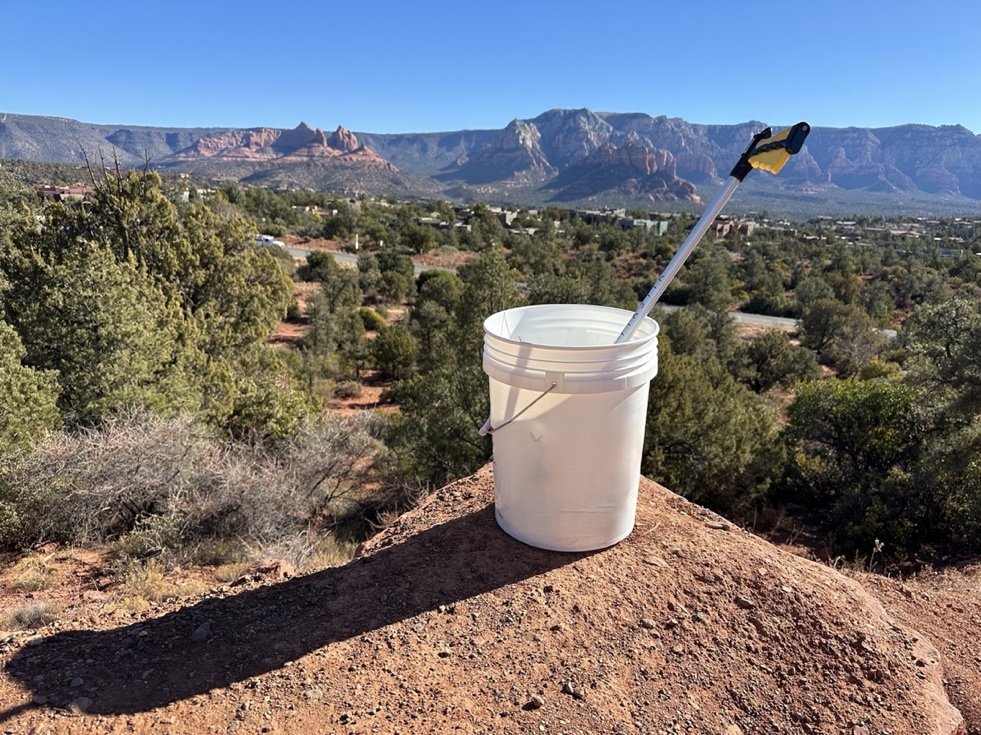
If being outdoors and cleaning up society's assault on nature's beauty is your thing, please join Keep Sedona Beautiful's team of dedicated litter lifters.
Two routes are now available:
- Upper Red Rock Loop Road from Red Rock High School to the low-water crossing sign just before Red Rock Crossing Road
- Red Rock Crossing Road from Chavez Ranch to Crescent Moon. You do not need to go into Crescent Moon to pick up litter there.
KSB assigns each litter lifter their own mile to clean. You get to be your own boss and clean it whenever you wish. We simply require that it be cleaned at least once per month. A mile typically includes both sides of the road. We will provide you with safety training and safety equipment, such as a picker, vest and large plastic bags in which to place the litter.
If you are hesitating to sign up for something permanent and would like to become familiar with our program, a great way to do so is to volunteer as a substitute. This allows you to get the training and clean a few different routes before deciding if obtaining a permanent position is right for you.
If you are interested in joining KSB's longest-standing volunteer program and would like to learn more, please contact Wendy at ksb2@keepsedonabeautiful.org.
Pick Up the Small Stuff
The KSB Micro-Trash program focuses on the small litter that many people miss, but that still harms the landscape. Bits of plastic, food wrappers, twist ties, tissues, bottle caps, and other tiny debris may seem minor, but they add up quickly. They affect the trail's beauty, can harm wildlife, and leave the wrong impression on others.
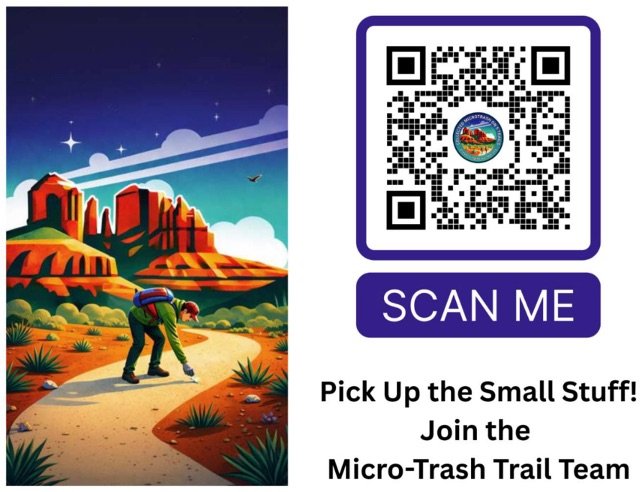
Join the Micro-Trash Trail Team to protect Sedona's trails one small piece at a time. Receive a Preserving the Wonder™ water bottle, certificate, and sticker at the $75 membership level.
At the $75 membership level, participants join this new effort and receive a Preserving the Wonder insulated metal water bottle, a certificate, and one Micro-Trash sticker. Sticker levels are available for 5 trails, 10 trails, 15 trails, and 25 trails. The program works on the honor system. We trust people to participate in good faith and take pride in helping care for this remarkable place.
Preserving the Wonder Legacy Family

Join the Legacy Family with a gift of $25,000 or more, and help Keep Sedona Beautiful become the sustainable, resilient organization you know it can be. Gifts of stock and other assets are welcome, and every contribution helps ensure our work continues for generations to come.
Legacy Family gifts support our Endowment Fund, managed by the Arizona Community Foundation. The fund's principal is protected. It can only be used in dire economic circumstances, and only if fundraising alone can't cover operating expenses. Interest earned from the fund can support ongoing programs, but only with approval from our Board of Trustees.
To learn more, contact Carla Williams, KSB President, at ksb@keepsedonabeautiful.org. We'd love to hear from you. Thank you for considering this lasting investment in Sedona's future.
KSB Business Sponsorship
KSB Business Sponsorship is an excellent way for businesses to support the protection of Red Rock Country. Levels range from Chimney Rock ($250) to Cathedral Rock ($20,000). Email ksb@keepsedonabeautiful.org or call (928) 282-4938 for more information. Pinch to zoom the page below for full benefit details.

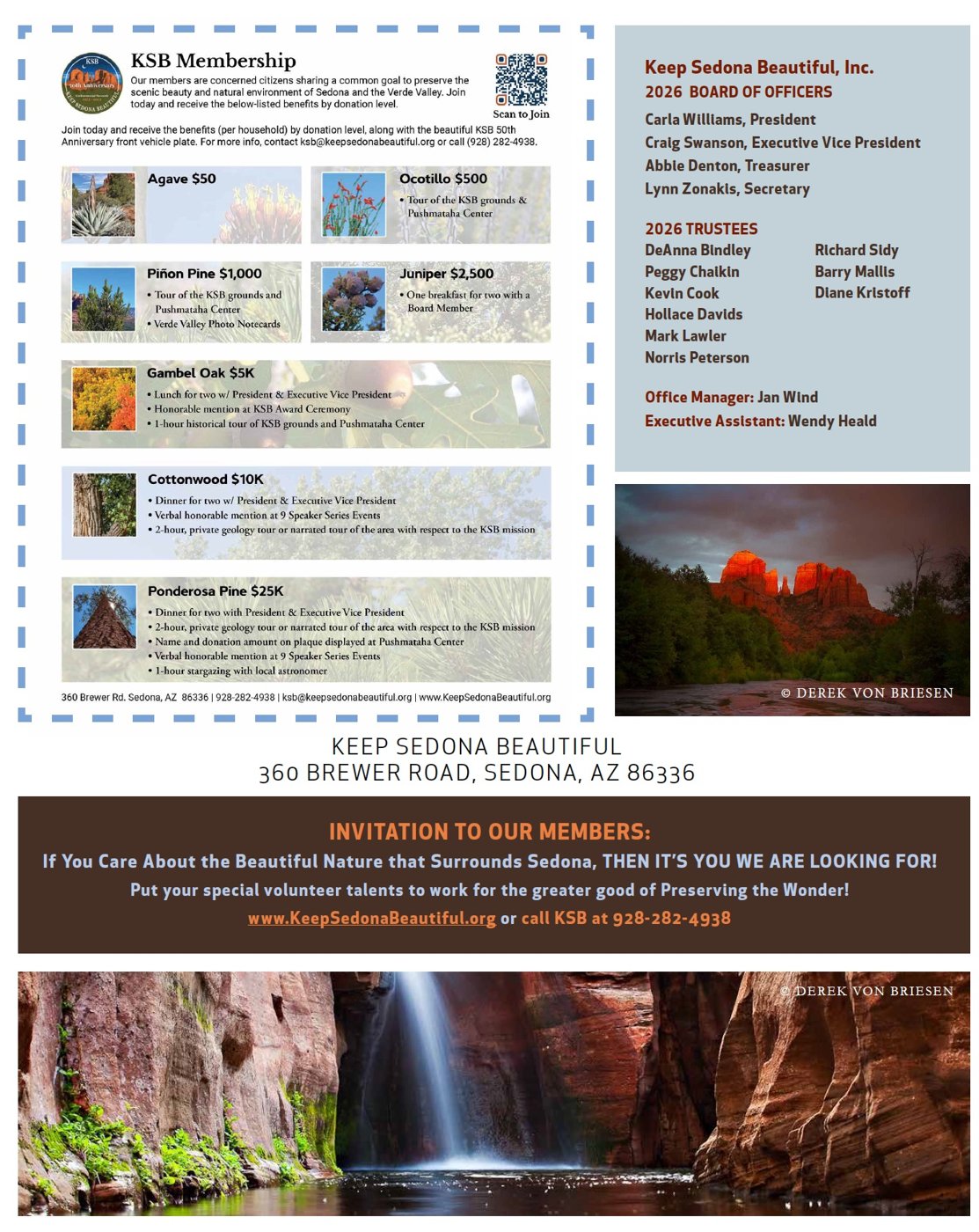
KSB Membership & 2026 Board
Membership levels range from Agave ($50) to Ponderosa Pine ($25K), each with benefits per household and a KSB 50th Anniversary front vehicle plate. Contact ksb@keepsedonabeautiful.org or call (928) 282-4938. Pinch to zoom the page below for details, the 2026 Board of Officers and Trustees, and our invitation to volunteer.
Thanks to Our Business Sponsors
Thanks to KSB's 2026 business sponsors, whose financial support helps us make a difference.